
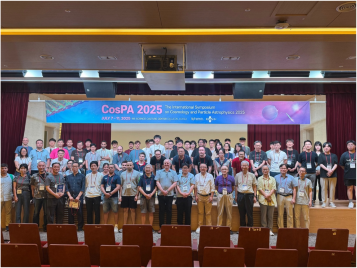
From July 7–11, 2025, the International Symposium on Cosmology and Particle Astrophysics (CosPA 2025) was held at the Institute for Basic Science (IBS) Science Culture Center in Daejeon, co-hosted by IBS Center for Theoretical Physics of the Universe – Center for the Geometry and Analysis of Spacetime (CTPU-CGA) and Korea Institute for Advanced Study (KIAS). CosPA is the annual Asia–Pacific meeting of the Asia Pacific Organization of Cosmology and Particle Astrophysics (APCosPA), a series now more than two decades old that brings together the communities of gravitation, cosmology, astrophysics, and particle astrophysics.
This year, Masahide Yamaguchi (director, IBS CTPU-CGA) served as the main organizer, with Bin Wang (Shanghai Jiao Tong Univ./Yangzhou Univ.) chairing the APCosPA council. The symposium was opened by Bin Wang and by Masahide Yamaguchi. Their speeches set a friendly, collaborative tone for the rest of the week.
The scientific program combined broad plenary talks with focused parallel sessions, aiming to keep ideas at the smallest scales and cosmic observables in close dialogue. Monday’s opening plenary session featured Raymond Volkas (Univ. of Melbourne) on axion cosmology and Mohammad Ali Gorji (IBS CTPU-CGA) on parity-violating stochastic gravitational-wave backgrounds. Tuesday’s session highlighted dark matter and dark-energy interactions with Kiwoon Choi (IBS CTPU-PTC), Stefano Scopel (Sogang Univ.), and Bin Wang, followed by talks on cogenesis and lepton asymmetry by Eung Jin Chun (KIAS), Masahiro Kawasaki (ICRR), and Ue-Li Pen (Academia Sinica). Mid-week, gravitational-wave cosmology came to the forefront with a session by Misao Sasaki (APCTP & IPMU), Rinku Maji (IBS CTPU-CGA), and Jun’ichi Yokoyama (U. of Tokyo), alongside sessions on early-universe dynamics and particle physics with contributions from Bum-Hoon Lee (CQUeST), Ryosuke Sato (Osaka Univ.), Yuta Hamada (KEK), and Phillip Urquijo (Univ. of Melbourne). Thursday and Friday’s topics turned to inflation, dark sectors, and primordial black holes, with presentations by Tomo Takahashi (Saga Univ.), Arman Shafieloo (KASI), Jounghun Lee (Seoul Nat’l Univ.), Xiao-Gang He (TDLI), David McKeen (TRIUMF), Spyros Sypsas (UBB), Shi Pi (ITP), and Ying-li Zhang (Tongji Univ.). The meeting as a whole emphasized gravitational-wave cosmology, dark-sector phenomenology, neutrino physics, and inflationary dynamics as cross-cutting themes.
A clear message from these sessions was how tightly “small” and “large” scales now connect. Particle-physics ideas—axions, light mediators, lepton asymmetry, and phase transitions—were discussed as explanations for cosmological and astrophysical signals, while cosmological data (including gravitational waves) were used to narrow particle models. The program’s stated aim—uniting theorists, experimentalists, and observers across gravity, cosmology, astrophysics, dark matter, and neutrinos—was evident throughout the symposium.
In addition, the council reviewed organizational matters and assessed future hosts. The council confirmed that CosPA 2026 will be held from July 6–10, 2026, in Christchurch, New Zealand, hosted by the University of Canterbury and held jointly with Australasian Conference on General Relativity and Gravitation (ACGRG-13) to strengthen scientific exchange between the Australia–New Zealand gravitation and gravitational-wave communities. It was also announced that the Pauchy Award for postdoctoral researchers will be launched at next year’s meeting, with further information to appear on the CosPA 2026 website.
By week’s end, the symposium closed with a renewed sense of shared purpose and focus on near-term observational tests, leaving participants with a concise snapshot of a field that is moving quickly, and yet moving together.
 .
.
C.L. Edmunds et al., Symmetry-protected topological Haldane phase on a qudit quantum processor. PRX Quantum 6, 020349 (2025)
I. Affleck, T. Kennedy, E.H. Lieb, H. Tasaki, Rigorous results on valence bond ground states in antiferromagnets. Phys. Rev. Lett. 59, 799 (1987)
Pham Van Ky, Nonstatic Reissner-Nordström metric in the perturbative f(R) theory: embedding in the background of the FLRW cosmology, uniqueness of solutions, the TOV equation. Eur. Phys. J. C 85(2), 170 (2025)
Springer Nature remains neutral with regard to jurisdictional claims in published maps and institutional affiliations.
If you'd like to subscribe to the AAPPS Bulletin newsletter,
enter your email below.
